How x402 is Building the 'Wallet' for the AI Web
How x402 is Building the “Wallet” for the AI Web
For thirty years, the internet has had a bug. It wasn’t a code error or a security vulnerability, but a missing piece of the foundation. In 1994, the architects of the web created a status code—HTTP 402 Payment Required—but they never finished building the technology to make it work.
Without a native way to send money over the internet, we built a web fueled by ads and data tracking. This worked for humans, but a new actor is entering the chat: Artificial Intelligence.
AI agents don’t watch ads, and they can’t fill out credit card forms. To function, they need a way to pay for data and services instantly and autonomously. This is where x402 comes in—a new protocol that finally fixes the internet’s “original sin” and paves the way for the Agentic Economy.
What is x402?
Think of x402 as a digital debit card built directly into the web browser’s code. It is an open payment standard that revives the dormant HTTP 402 status code to allow machines to pay other machines for data, access, or services without human intervention.
Currently, if you want to access premium data, you encounter a “403 Forbidden” error or a login screen. With x402, the server simply replies “Payment Required” and tells your software exactly how much crypto (like USDC) it costs to proceed. Your software pays it instantly, and the door opens.
This shifts payments from “Systems of Engagement” (like a Stripe checkout page designed for human eyes) to “Systems of Execution” (code that just gets the job done).
How It Works: The “Digital Handshake”
The magic of x402 happens in the background. It changes the conversation between your computer (the Client) and the website (the Server).
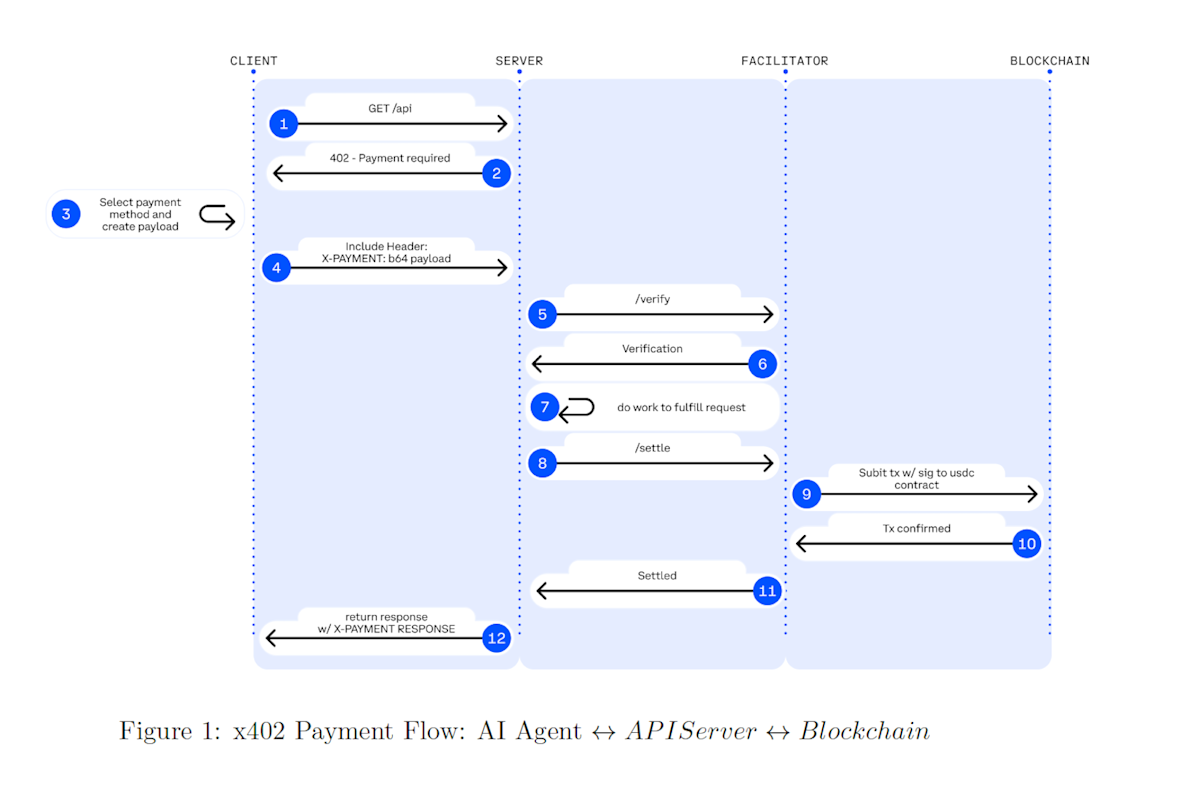
Here is the step-by-step flow of an x402 transaction:
- The Knock (Request): An AI agent tries to access a paid service (e.g., “Get me the latest stock prices”).
- The Challenge (402 Response): instead of blocking the agent, the server replies with a 402 error. It attaches a “price tag” in the header saying, “I accept 0.01 USDC on the Base network”.
- The Commitment (Signing): The agent’s digital wallet sees the price tag. It cryptographically signs a promise to pay. This is like signing a check without handing it over yet.
- The Entry (X-PAYMENT Header): The agent knocks again, this time showing the signed check in a special header called
X-PAYMENT. - The Settlement (Facilitator): The server checks the signature. To avoid dealing with complex blockchain fees and slowness, the server uses a “Facilitator”—a middleman service—to process the crypto transaction on the blockchain. Once confirmed, the agent gets the data.
Why the “Facilitator” Matters
You might wonder, why use a middleman? In the crypto world, paying a $0.01 fee might cost $5.00 in “gas” (transaction fees) if you aren’t careful. Facilitators bundle these transactions to make them cheap and handle the complex technical work, so website developers don’t have to run their own blockchain nodes.
The “Golden Triangle”: Why AI Needs This
x402 solves the payment problem, but it’s part of a larger ecosystem necessary for autonomous agents to survive. In the future, “Trust” will be just as important as money.
Security experts call this the Golden Triangle of Agentic Commerce:
- Payment (x402): The agent has the funds to pay immediately.
- Identity (ERC-8004): A standard that lets an agent prove who it is (e.g., “I am a verified travel bot”) without relying on Google or Facebook logins.
- Reputation: An on-chain history that proves the agent acts well. A server can block agents with bad reputation scores to prevent spam or attacks.
Real-World Examples
New platforms are already using this:
- Daydreams: A marketplace where agents can “shop” for the smartest AI model for a specific task, paying per-second for brainpower.
- Unibase: A “memory layer” where agents pay to store what they learn, so they don’t forget it when they reboot.
Future Outlook: A Tale of Two Webs
We are heading toward a bifurcation (splitting) of the internet:
- The Human Web: The internet we know today—visual, slow, and full of ads.
- The Agent Web: A high-speed, invisible layer where AI agents trade data and services using x402, paying tiny fractions of a cent for every interaction.
For cybersecurity professionals, this changes the game. We are moving from protecting user accounts (passwords) to protecting digital wallets and agent identities. The “Robot Tax”—charging a tiny fee for access—might actually save the web from spam and DDoS attacks, as it becomes too expensive for bad actors to flood servers with junk traffic.
x402 isn’t just a new way to pay; it’s the financial nervous system for the next generation of the internet.
Coinbase official launch on May 2025: https://www.coinbase.com/en-es/developer-platform/discover/launches/x402